Supporting Independent Play Skills.
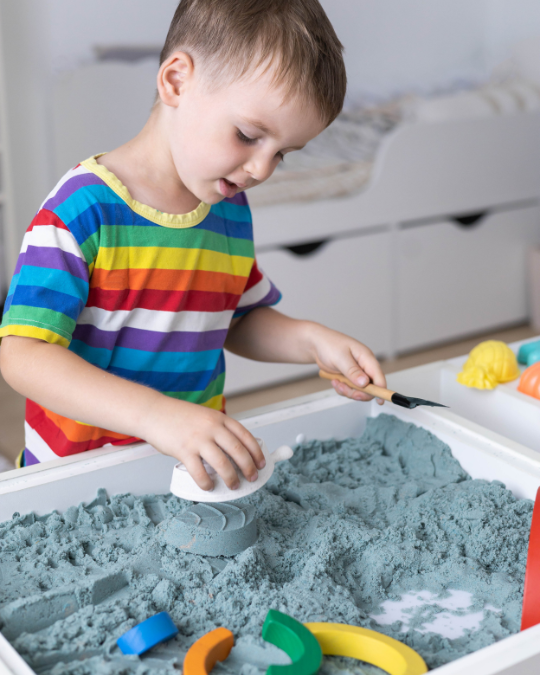
Independent play is one of the most important developmental milestones a child can build — and one of the most commonly misunderstood. It is not a binary skill that a child either has or doesn't have. It is a developmental muscle that requires consistent training, environmental support, and the gradual fading of adult involvement over time.
For many children, particularly those who have become accustomed to constant adult-led interaction, the prospect of playing alone can feel genuinely daunting. At NeuroCore, we view independent play not as a way to occupy a child while caregivers step away, but as a crucial developmental milestone one that allows a child to discover their own interests, build internal confidence, and practice the executive functioning skills required to sustain meaningful engagement with their world.
Step One: Environmental Engineering
If a child is consistently struggling to play independently, the first place to look is the play environment itself. The space around a child is never neutral it either supports independent play or works against it.
A room filled with too many toys creates a visually and cognitively overwhelming landscape that leads to decision fatigue. Rather than settling into an activity, the child feels paralyzed by the volume of options and defaults to seeking an adult to help them choose. This is not a behavioral problem — it is a predictable response to an environment that has inadvertently made independent play harder than it needs to be.
At NeuroCore, we recommend simplifying the play space significantly and offering a small, rotating selection of materials that encourage open-ended exploration — blocks, art supplies, sensory materials, or simple construction sets. The goal is an environment that functions as a constant, quiet invitation to play, rather than a cluttered space that requires adult management to navigate. When the environment is right, independent play becomes the path of least resistance.
Step Two: Fading Your Presence Gradually
Once the environment is set up to support independent play, the next step is deliberately and gradually reducing adult involvement a process we refer to as active withdrawal.
Many caregivers fall into the role of play-by-play commentator without realizing it: narrating the child's actions, offering praise after every move, or suggesting the next step. While these interactions are entirely well-intentioned, they effectively transform the child's play into a social activity that depends on ongoing adult participation. Without meaning to, the caregiver has become a required ingredient in the play — and the child simply cannot engage without them.
Active withdrawal involves staying physically present in the room while intentionally disengaging from the child's play. You might be nearby reading, working quietly, or completing a household task. Your presence remains as a secure attachment anchor — the child knows you are available — but you are no longer a participant in what they are doing. This creates the conditions for a child to experience the deep satisfaction of completing a sequence of play entirely on their own, reinforcing their belief in their own capability.
Step Three: Using Play Prompts to Build Endurance
Independent play, like any developmental skill, is built incrementally. Expecting a child who has never played alone for more than a minute to suddenly sustain twenty minutes of solo exploration is setting them up to struggle.
NeuroCore therapists use structured play prompts to build endurance gradually. We begin by asking a child to engage in just two to three minutes of solo play, then immediately follow that success with a moment of high-quality, focused shared play as a natural reward. This structure teaches the child something important: independent play is not a punishment or a separation from the people they love. It is a gateway to the connection they value.
As the child demonstrates increasing comfort at each interval, we slowly extend the duration. It is essential to watch for signs of distress — if a child is becoming dysregulated, the intervals are growing too quickly for their current developmental stage. We always aim to stay within the child's comfort zone, providing just enough support to keep them regulated and successful, and increasing the challenge only as genuine confidence grows.
The Bigger Picture: Honouring Autonomy
At the heart of building independent play skills is a commitment to honouring a child's autonomy. When we give a child the space to explore their own ideas even when those ideas look very different from how we might play we are validating their internal world. We are sending a clear and powerful message: your imagination is valuable, your efforts are enough, and you are capable of more than you know.
This is the essence of NeuroCore's dignity-first approach. We are not trying to change who a child is. We are providing the scaffolding that allows them to discover how genuinely capable they already are.
How NeuroCore Can Help
If the transition toward more independent play at home feels like an uphill struggle, our clinical team is here to partner with you. We conduct detailed assessments of your child's current play environment and interaction patterns, and build a customized, gradual plan that respects your child's unique developmental needs while steadily building the independence and confidence they need to flourish.
If you have concerns about your child's development, consult our BCBA or your pediatrician.