How ABA Therapy Supports Children With Down Syndrome in Dubai
October is Down Syndrome Awareness Month. At NeuroCore, we want to use this month to talk honestly and specifically about something families of children with Down Syndrome often ask us: can ABA therapy help my child, and what does that support actually look like?
The straightforward answer is yes. ABA therapy supports children with Down Syndrome in meaningful, practical ways. Not because Down Syndrome and autism are the same, they are not, but because the principles of Applied Behavior Analysis, systematic skill teaching, reinforcement-based learning, and a functional approach to understanding behaviour, are effective across a range of neurodevelopmental profiles.
What Down Syndrome Is
Down Syndrome is a genetic condition that occurs when a person is born with an extra copy of chromosome 21. It is one of the most common chromosomal conditions globally and it affects development in ways that vary significantly from person to person.
Children with Down Syndrome typically have some degree of intellectual disability, which means they may take longer to develop skills and may need more repetition and support to consolidate learning than their peers. Many children with Down Syndrome also have differences in communication development, including delayed speech, differences in language comprehension, and for some children, the use of sign language or AAC devices alongside or instead of spoken words.
Physical characteristics associated with Down Syndrome include differences in muscle tone, which can affect fine and gross motor development, and a higher likelihood of certain medical conditions including heart conditions, hearing differences, and thyroid differences, all of which may affect a child's learning and development.
Where ABA Therapy Contributes
ABA therapy is particularly effective for children with Down Syndrome in the following areas.
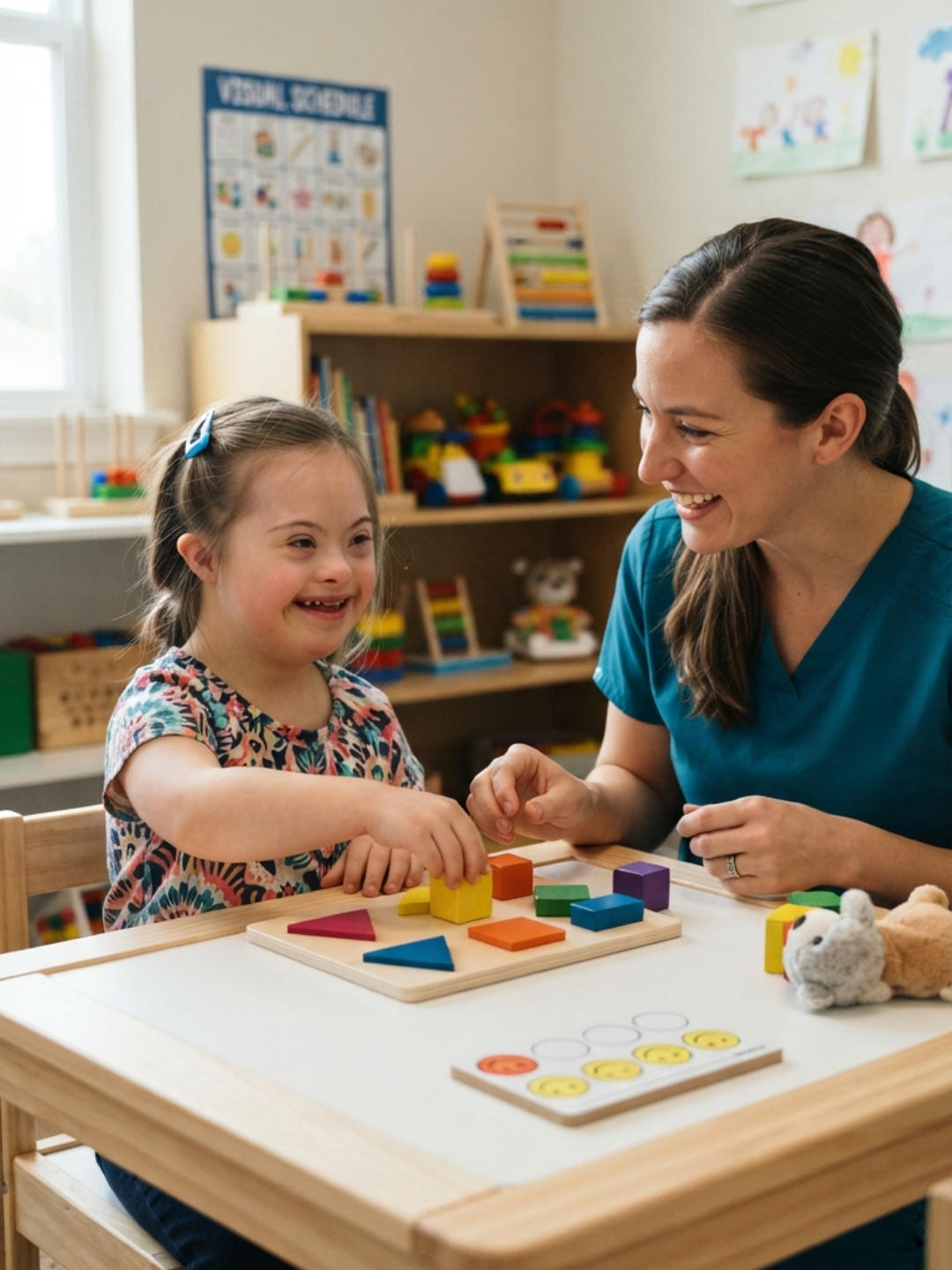
Communication development is often one of the most significant areas of support. ABA uses the same systematic teaching approaches for building communication in children with Down Syndrome as it does for children with autism, with appropriate adaptation for the specific profile. This includes building requesting skills, developing vocabulary, supporting the use of sign language or AAC devices, and helping the child generalise their communication skills across different settings and communication partners.
Daily living skills are another area where ABA produces meaningful outcomes. Children with Down Syndrome often benefit from the structured, step-by-step teaching approach of ABA when learning skills like dressing, personal hygiene, food preparation, and domestic routines. Task analysis, which is the breaking down of a complex skill into its smallest teachable components, is a core ABA strategy that is particularly well-suited to building these skills systematically.
Academic readiness skills, including attending to tasks, following instructions, sitting and participating in structured activities, and transitioning between activities, are also supported effectively through ABA. These skills are often targeted in the early years as preparation for the school environment and are essential for a child with Down Syndrome to benefit from the educational opportunities available to them.
Behaviour support is relevant for some children with Down Syndrome who engage in challenging behaviour that interferes with their learning or daily functioning. As with all ABA behaviour support, the starting point is understanding the function of the behaviour rather than simply attempting to stop it. Many challenging behaviours in children with Down Syndrome are communicative, expressions of frustration, requests for attention, or responses to demands that exceed current capacity. ABA addresses the underlying function while building more effective alternatives.
How ABA Differs From Other Approaches for Children With Down Syndrome
Several other therapy approaches are commonly used to support children with Down Syndrome, including speech and language therapy, occupational therapy, and physiotherapy. ABA does not replace these. It works alongside them.
The specific contribution ABA makes is the systematic teaching of functional skills using reinforcement-based strategies, combined with ongoing data collection that allows the programme to be continuously adjusted based on the child's actual progress. This data-driven, systematic approach complements the more specialist focus of speech, occupational and physiotherapy.
What Families in Dubai Should Know
If your child has Down Syndrome and you are considering ABA therapy in Dubai, look for a provider whose team has experience working with children across a range of neurodevelopmental profiles, not only autism. Ask specifically what experience they have with Down Syndrome and what their approach looks like for a child with your child's specific profile.
At NeuroCore, we work with children with a range of diagnoses and developmental profiles. Our clinical approach is always built around the individual child rather than the diagnostic label.
If you have concerns about your child's development, consult our BCBA or your pediatrician.