How ABA Strategies Help Dubai Teachers Build More Inclusive Classrooms
Inclusion in Dubai's schools is not just an aspiration. It is increasingly a regulatory expectation, with the KHDA setting clear standards for how schools support students with special educational needs in mainstream settings. But for many classroom teachers, the gap between the policy of inclusion and the practical reality of supporting a student with autism or developmental differences alongside twenty-five other children can feel significant.
ABA therapy is not only something that happens in a child's home or in a specialist setting. The principles and strategies that drive effective ABA practice translate directly into classroom environments and give teachers concrete, evidence-based tools for making inclusion genuinely work.
The ABA Principle That Changes Everything for Teachers
The most important shift ABA brings to classroom practice is a change in how behaviour is understood.
In many traditional classroom management approaches, challenging behaviour is understood as defiance, attention-seeking, or a motivational failure. The response tends to be consequence-based. Sanctions, removal, or the withholding of privileges.
ABA approaches the same behaviour completely differently. Every behaviour serves a function. A student who disrupts a lesson is communicating something. Maybe the task is too difficult and they are escaping it. Maybe they need attention and have found that disruption reliably produces it. Maybe the sensory environment of the classroom is overwhelming and the behaviour is an attempt to regulate.
When a teacher understands the function of a behaviour rather than just reacting to its surface appearance, the response becomes targeted rather than reactive. And targeted responses produce lasting change in a way that reactive consequences rarely do.
Visual Supports: The ABA Tool Every Teacher Can Use
One of the most immediately practical ABA strategies for classroom teachers is the use of visual supports. These are not specialist resources that require clinical training to implement. They are simple, low-cost tools that reduce the cognitive load on students and make the structure of the classroom day visible and predictable.
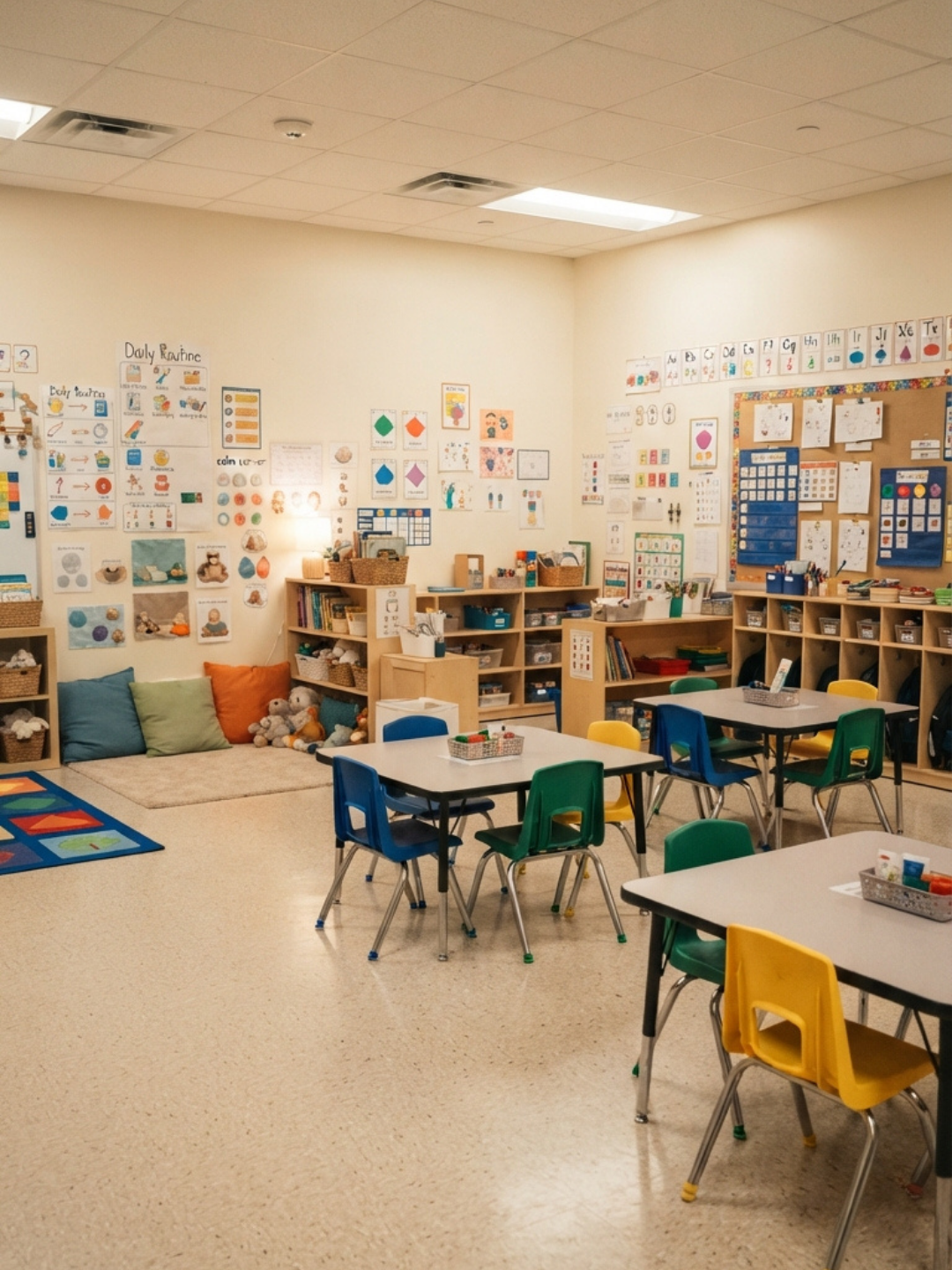
A visual daily schedule posted at the front of the classroom tells every student what is coming next. For students with autism or anxiety this is particularly significant. Knowing the structure of the day reduces the nervous system activation that comes from uncertainty, which means more regulatory capacity is available for learning.
Task checklists break complex instructions into visible sequential steps. A student who struggles to hold a multi-step instruction in working memory can follow a checklist independently without requiring repeated adult prompting. This builds independence and reduces the friction in the teacher-student relationship.
Visual timers make the duration of activities concrete rather than abstract. A student who cannot yet reliably track time internally can see how long an activity will last and how long until it ends. This makes transitions significantly more manageable.
Positive Reinforcement: Using It Deliberately Rather Than Accidentally
Every classroom already uses reinforcement. The question is whether it is being used deliberately to increase the behaviours that support learning, or accidentally to maintain the behaviours that disrupt it.
A student who receives attention from the teacher only when they call out or leave their seat has learned that these behaviours produce a reliable result. The attention is reinforcing the disruption, regardless of the teacher's intention.
ABA asks teachers to notice and respond to the behaviours they want to see more of, with the same consistency and immediacy that challenging behaviour tends to attract. Specific, immediate, genuine positive feedback following on-task behaviour, appropriate requesting, or successful transitions builds those behaviours over time in exactly the same way that attention following disruption builds disruption.
This does not mean ignoring challenging behaviour. It means being as strategic about reinforcing the positive as the classroom environment currently is about inadvertently reinforcing the negative.
Consistent Language and Predictable Routines
Students with autism and many other developmental differences function significantly better in environments that are linguistically and structurally predictable. When the same words are used for the same things every day, when transitions follow the same sequence, when the rules of the classroom are clear and consistent, the cognitive demand of simply being in the classroom is reduced.
ABA practitioners are trained to use clear, concise, consistent language when giving instructions. Short, direct sentences. One instruction at a time. Consistent vocabulary for recurring situations. These same principles apply in the classroom and produce measurable improvements in student compliance and engagement when applied consistently.
The Calm Corner: Making Regulation a Classroom Norm
One of the most impactful structural changes a Dubai classroom teacher can make, informed by ABA practice, is the introduction of a designated regulation space. A calm corner is not a consequence space. It is not where students are sent when they misbehave. It is a proactive resource that any student can access when they feel their regulation is slipping, before they reach the point of disruption.
When this space is introduced to the whole class as a shared resource, normalised from the beginning of the year, and used proactively rather than reactively, it shifts the classroom culture in a meaningful way. Students learn to recognise their own regulatory needs and respond to them independently. This is one of the core goals of ABA practice and it is entirely achievable within a mainstream classroom with the right structural support in place.
How NeuroCore Supports Dubai Teachers
At NeuroCore, when we work with children who are also attending school in Dubai, we actively share ABA strategies with classroom teachers and learning support staff. We help translate clinical language into classroom-applicable practice and ensure that the strategies working at home are also available to the adults working with the child at school.
If your school would like support building ABA-informed inclusive practice across your teaching team, our clinical team is happy to discuss what that could look like.
If you have concerns about a student's development, encourage the family to consult our BCBA or their pediatrician.