What Independent Play for Toddlers Looks Like
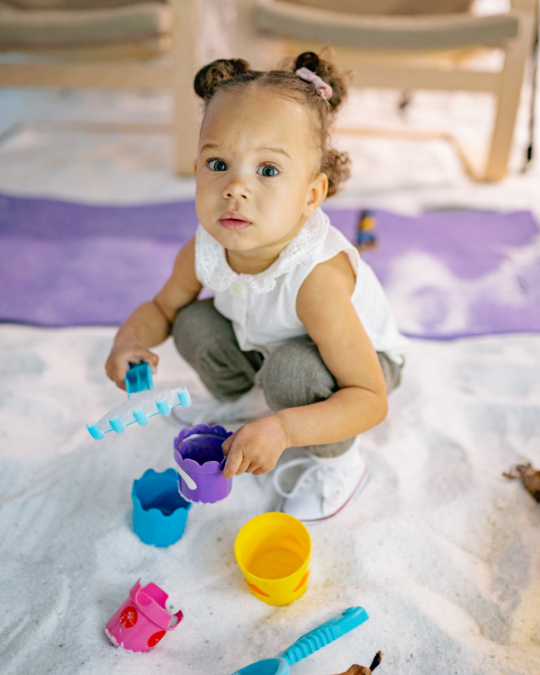
When we talk about independent play for toddlers, the first and most important step is recalibrating our expectations to match the child's actual developmental stage. Independent play is not about a toddler disappearing into their room for an hour while caregivers get things done. It is about a toddler's growing ability to engage with their environment, manipulate objects, and explore their own ideas without requiring constant adult facilitation.
At NeuroCore, we define independent play in toddlers as self-directed exploration a toddler deeply absorbed in stacking blocks, discovering the texture of a sensory bin, or moving objects from one container to another with focused intention. These seemingly simple actions are anything but trivial. They are the earliest building blocks of executive functioning: the child is practising planning, persistence, and problem-solving through their own intrinsic motivation, entirely on their own terms.
Independent Play Is an Active Cognitive Process
One of the most important reframes NeuroCore helps families make is this: independent play is not a passive activity. For a toddler, the world is a giant laboratory, and independent play is their research.
When you observe a toddler trying to fit a round peg into a square hole, lining up cars in a specific sequence, or dropping objects repeatedly from different heights, they are not simply filling time. They are actively testing the laws of physics, spatial relationships, and cause and effect forming and revising hypotheses in real time, in the only way a toddler knows how.
The role of the adult during this process is to be a supportive observer rather than an active director. This means creating what we call a "yes environment" a space where the toddler can safely explore without frequently encountering "no" or "don't touch." When the environment is designed to say yes, the toddler can develop the genuine confidence that comes from solving their own small, everyday challenges independently.
What Independent Play Actually Looks Like at This Age
It is also important to recognise that independent play for toddlers is naturally fleeting and episodic and this is entirely developmentally appropriate.
At this stage, the ability to sustain attention on a single task is naturally short. A toddler who moves quickly from one activity to the next is not demonstrating a lack of focus. They are engaging in rapid-fire exploration, following their curiosity from one discovery to the next in the way their developing brain is designed to do.
At NeuroCore, we support this by helping families offer a curated, limited selection of open-ended materials rather than complex, single-function toys. A set of basic wooden blocks, soft scarves, stacking cups, or a simple sensory bin provides far more opportunity for genuine independent exploration than a battery-operated toy that dictates exactly how the child should interact with it. When the toddler is the one driving the action deciding what to build, how to sort, what to try next they are laying the critical foundation for future agency and self-directed learning.
The Connection Between Security and Independent Play
One of the most important distinctions NeuroCore helps families understand is the difference between a toddler who is playing independently because they feel secure, and a toddler who is playing alone because they feel disconnected or ignored. These two situations look identical from a distance but they produce very different outcomes.
The most successful independent play consistently follows a period of genuine, quality connection with a caregiver. When a toddler's connection cup is full when they have received focused, warm, responsive attention they are far more likely to venture out into independent exploration with confidence and ease.
This is also why the most productive independent play often happens when a caregiver is physically nearby, quietly engaged in their own task. The toddler does not need the adult to participate — but their nearby presence acts as a secure attachment anchor. The child knows that support is available if they need it, which paradoxically gives them the confidence to remain engaged in their own activity for longer, without anxiety or interruption.
Supporting the Journey Toward Autonomy
Ultimately, independent play is not about teaching a toddler to be solitary. It is about nurturing their belief in their own capability giving them repeated, reliable experiences of figuring something out, completing something, or discovering something entirely through their own effort.
As a toddler grows, these moments of independent exploration naturally lengthen and deepen in complexity. The NeuroCore clinical goal is to support this journey by providing the right environment, the right materials, and the right level of adult presence not too much, and not too little so that each child can develop at their own pace, with confidence and curiosity intact.
How NeuroCore Can Help
If you are interested in creating a home environment that genuinely promotes self-directed exploration and growing independence in your toddler, our clinical team is here to partner with you. We assess your current play space, identify the specific adjustments that would best support your child's developmental stage, and work with your family to build the conditions where independent play can genuinely thrive.
If you have concerns about your child's development, consult our BCBA or your pediatrician.