Using ABA to Support Toilet Training for Children with Autism
Toilet training is one of the topics families bring to NeuroCore most often. It is also one of the topics that carries the most anxiety, partly because there is so much conflicting advice out there, and partly because when it is not going well, it affects the whole household every single day.
If your child with autism has not yet toilet trained, or if previous attempts have not worked, this guide is for you. ABA offers a structured, practical approach to toilet training that is built around your child specifically, not a generic timeline or method.
First, Let Go of the Timeline
The single most unhelpful thing about most toilet training advice is that it comes with an age attached. "Most children are toilet trained by three." "If your child is not trained by four, talk to your doctor."
For children with autism, these timelines are largely irrelevant. Toilet training readiness depends on a child's sensory profile, their communication skills, their ability to follow a sequence of steps, and their awareness of their own body, not their age.
Trying to toilet train a child who is not yet ready, or using methods that do not account for their sensory and communication needs, tends to make the process harder and longer, not shorter. Waiting until the conditions are right and using the right approach makes a real difference.
What Makes Toilet Training Harder for Children with Autism
Understanding the specific challenges helps you address them directly rather than trying to push through them.
Some children with autism have reduced body awareness, which means they genuinely do not feel the sensation of needing to use the toilet until it is already urgent or too late. No amount of reminding or visual prompting will fix this on its own. The approach needs to account for it.
Some children find the sensory experience of the bathroom overwhelming. The sound of a flushing toilet can be distressing. The feeling of sitting on a cold seat can be uncomfortable. The echo in a tiled room can feel amplified. Any of these can create an association between the toilet and discomfort that makes the whole process feel threatening.
Some children have difficulty with the multi-step sequence that toilet training requires. Getting to the bathroom, pulling down clothing, sitting, waiting, wiping, pulling clothing back up, flushing, washing hands. Each of these is a separate step, and for a child with executive functioning differences, holding that whole sequence in mind is a real challenge.
Some children are simply not motivated by the social praise that typically developing children respond to. "Good job" means very little if the child does not find social attention reinforcing.
ABA addresses all of these factors directly.
The ABA Approach to Toilet Training
The first step in any ABA-based toilet training plan is understanding your child's specific starting point. This means assessing their current body awareness, their communication skills, their sensory sensitivities around the bathroom environment, and what actually motivates them.
From there, a plan is built around three things: schedule, consistency, and reinforcement.
Schedule means taking your child to the toilet at regular, predictable intervals throughout the day rather than waiting for them to signal a need. For children with reduced body awareness, this removes the reliance on a sensation they may not yet reliably detect. Over time, as success builds and awareness develops, the schedule is gradually adjusted.
Consistency means the same routine, the same words, the same sequence of steps, every single time. For a child who finds the multi-step nature of toilet training confusing, consistency reduces the cognitive load. The routine becomes familiar. Familiar becomes manageable.
Reinforcement means finding what your child genuinely finds motivating and using it immediately and specifically when they succeed. Not a sticker chart they do not understand. Not verbal praise they do not respond to. The actual thing they love most, given the moment they succeed, so the connection between the behaviour and the reward is clear.
Addressing Sensory Barriers
If the bathroom environment is causing distress, the plan needs to address that directly before anything else can work.
This might mean introducing the bathroom gradually, starting with just sitting on the closed toilet seat fully clothed with no expectation. It might mean using a child-sized toilet seat insert for a child who feels unsafe on a full-sized seat. It might mean a visual timer so the child knows how long they need to sit. It might mean addressing the flushing sound separately, letting the child control the flush when they feel ready rather than building it into the routine from the start.
These adjustments are not indulgences. They are clinical decisions that remove barriers to progress.
Visual Supports
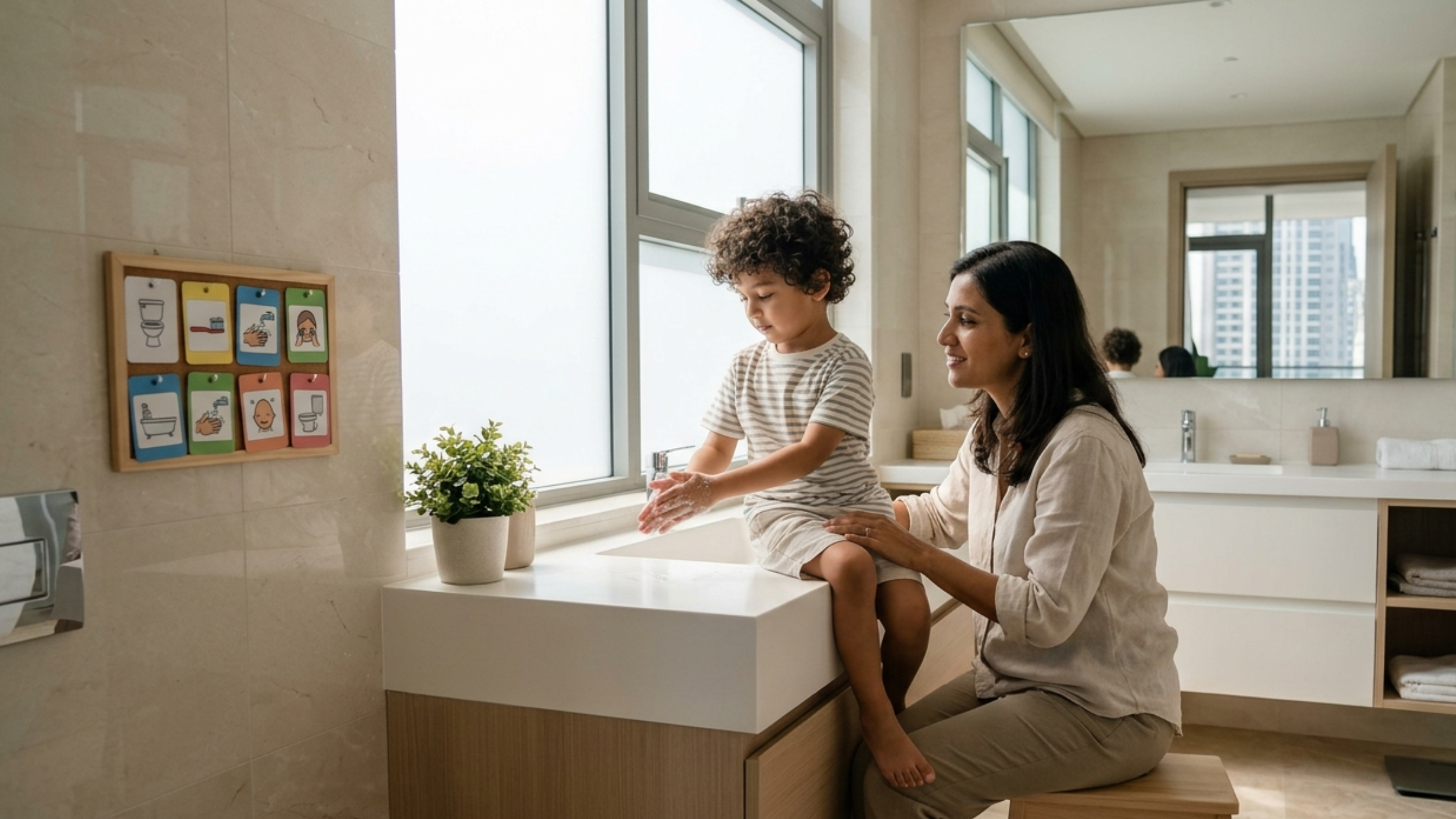
A simple visual sequence showing the steps of the toilet routine posted on the bathroom wall does two things. It gives the child a roadmap they can follow without relying entirely on adult prompting. And it takes the friction out of the adult-child dynamic because the visual, not the parent, is directing each step.
Keep the visual simple. Pictures or simple words, in the order the steps actually happen. Point to each one as you move through the routine until your child can follow it independently.
What to Do When It Is Not Working
If toilet training has stalled or previous attempts have created anxiety around the bathroom, the first step is to reduce the pressure completely. Step back from any approach that is creating distress and give your child time to rebuild a neutral or positive association with the bathroom before trying again.
This feels counterintuitive when you are tired and frustrated and just want it to be resolved. But pushing through resistance in toilet training almost always makes things harder in the long run.
A fresh start with a properly built plan, supported by a clinician who understands your child's specific profile, tends to produce much faster progress than continuing with an approach that is not working.
How NeuroCore Can Help
At NeuroCore, toilet training is one of the most common areas we support families with. We assess your child's specific starting point, identify the barriers that are making progress difficult, and build a plan that is realistic, consistent, and matched to how your child actually learns.
If toilet training is causing daily stress in your household, our clinical team is here to help.
If you have concerns about your child's development, consult our BCBA or your pediatrician.