How ABA Strategies Support Student Mental Health in Dubai Schools
Today is World Mental Health Day, an annual initiative of the World Health Organization that is actively promoted by healthcare and education authorities across the UAE. This year we want to focus on something specific: how the strategies and principles of ABA therapy can support mental health and emotional wellbeing for students in Dubai's classrooms.
Mental health in children is not just about the absence of a diagnosable condition. It is about a child's ability to regulate their emotions, manage stress, build positive relationships, and experience their school environment as a safe and manageable place. For many students in Dubai, particularly those with autism, ADHD, anxiety, or other developmental differences, these capacities require deliberate support.
The Connection Between Regulation and Wellbeing
ABA practice places emotional regulation at the centre of clinical work with children who have developmental differences. The reason is straightforward: a child who is chronically dysregulated cannot learn effectively, cannot build positive social relationships, and cannot experience school as a safe or rewarding environment.
This is as much a mental health concern as it is a behavioural one. A child who spends their school day in a state of elevated anxiety, who cannot access their regulatory resources reliably, and who accumulates daily stress without adequate recovery is a child whose mental health is being affected by their school experience. The strategies ABA uses to support regulation are directly relevant to improving that experience.
Practical ABA Strategies That Support Wellbeing in Schools
Creating predictability reduces anxiety. One of the most reliable ways to reduce anxiety in students with developmental differences is to make the school environment more predictable. Visual schedules, consistent routines, advance warnings before transitions, and clear and consistent expectations all reduce the cognitive and emotional load of simply being in school. A student who knows what is coming next, who understands the rules of their environment, and who can rely on the adults around them to behave consistently is a student who has significantly less reason to be anxious.
Building self-regulation skills explicitly. Self-regulation is a skill that can be taught. ABA practice targets self-regulation by teaching children to recognise the early physical signals of emotional escalation, to use specific strategies to manage those signals before they become overwhelming, and to request support when they need it. These skills do not develop automatically for many children with developmental differences. They require deliberate, systematic teaching.
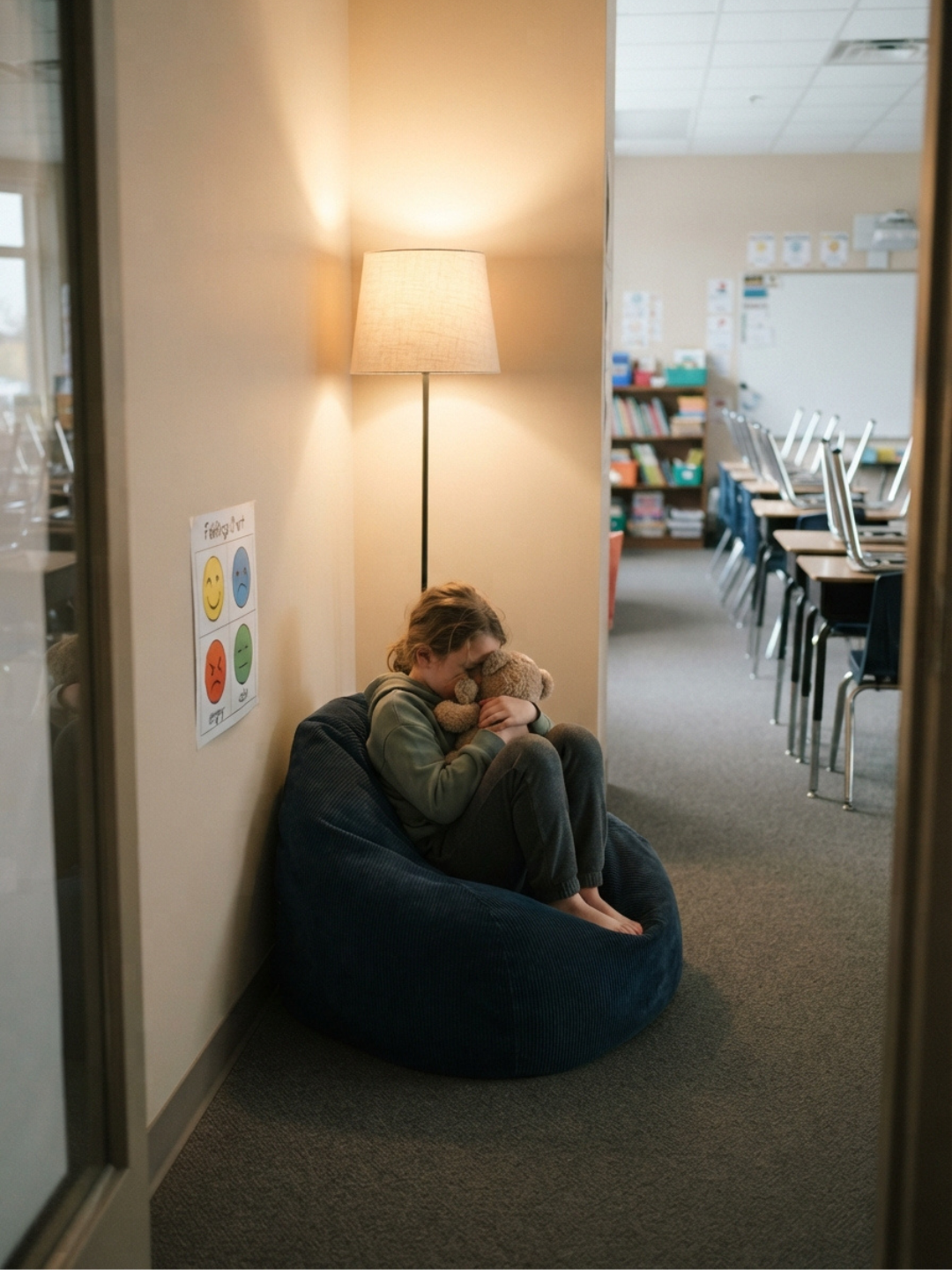
Creating accessible emotional safety valves. A calm corner in the classroom, accessible without permission and without stigma, gives students a physical option for regulation that does not require them to manage the social complexity of asking for help at the moment they are least able to do so. This is a structural support drawn directly from ABA practice that has measurable effects on both behaviour and wellbeing.
Reinforcing positive experience deliberately. ABA's emphasis on catching and reinforcing the behaviours we want to see more of has a direct wellbeing dimension. A student who receives consistent, genuine, specific positive attention for managing a hard moment, for asking for help appropriately, for trying something difficult, develops a different relationship with their school experience than one whose interactions with adults are primarily corrective. The ratio of positive to corrective interactions in a classroom is a wellbeing variable as much as a behavioural one.
How Families Can Support Mental Health at Home
The mental health of a child with developmental differences is not shaped only by the school environment. What happens at home matters enormously.
The after-school decompression period, the quality of sleep, the predictability of home routines, the family's own stress levels and how those are managed within the home. All of these shape the regulatory baseline from which a child begins each school day.
ABA parent coaching, which is a core component of NeuroCore's programmes, addresses these home-based factors directly. We work with families to build the home conditions that support their child's regulation and wellbeing, not just the strategies that address specific skills or behaviours.
If you have concerns about your child's development or mental health, consult our BCBA or your pediatrician.